Building agentic architectures and LLM inference systems that reason reliably at scale
MS Applied Machine Learning • University of Maryland
Understanding where and why reasoning silently fails
Current Work
I discover critical bugs in LLM systems that cause silent reasoning failures. Recently, I found that vLLM's calibrated FP8 KV-cache mode collapses reasoning on AIME and GSM8K (3% vs 73% correct), while int8_per_token_head matches the unquantized baseline, and built a linear probe that predicts stuck reasoning chains from model activations (AUC 0.612 vs 0.445 baseline).
My research on quantization-induced reasoning failures is available on arXiv, and my work on mechanistic early detection of reasoning non-convergence was accepted to the COLM 2026 Efficient Reasoning Workshop. I prioritize reproducibility and rigorous evaluation, backing every claim with significance testing and controlled baselines.
AI systems spanning LLM inference and agentic architectures
NL-to-SQL Agent: Schema Retrieval, Self-Correction, Cost-Aware Routing
LangGraph agent with schema retrieval, execute-and-self-correct, and Haiku→Sonnet routing. On all 1,534 BIRD dev questions: 66.6% execution accuracy vs 63.6% baseline (McNemar p=0.0001) at 0.18¢ per question, with ablations and a failure taxonomy.
View on GitHub →Crop Disease Detection: Lab-to-Field Generalization
Showed that lab-trained classifiers (99% on PlantVillage) drop to 24–38% on real field photos because they learn the background; ten real field photos per class recover 45–78% of the gap, far more than GAN or VAE augmentation. Live Hugging Face demo.
View on GitHub →Real-Time ECG Classification with a Signal-Quality Gate
Multi-label ECG classifier on PTB-XL: 0.932 macro AUROC at 8.9 ms p95 on a laptop CPU. An autoencoder quality gate refuses noisy signals instead of guessing. Architecture chosen under a fixed CPU latency budget.
View on GitHub →Multi-Agent Factcheck System
Adversarial multi-agent system for fact verification: Confirmer, Refuter and Contextualizer agents debate each claim with Wikipedia evidence, and a synthesizer gives a calibrated verdict. On 160 FEVER claims: 71.2% accuracy vs 49.4% for single-model GPT-4, with 2.4× lower calibration error.
View on GitHub →Inference Server: Continuous Batching + Paged KV-Cache
Built three LLM serving backends from scratch to compare naive serial, static batching, and continuous batching with paged attention. Continuous batching lifted throughput 16% and cut p99 latency from 34.8 s to 10.9 s under mixed-length load.
View on GitHub →vLLM KV-Cache Quantization Reasoning Evaluation
Investigated whether vLLM's KV-cache quantization modes cause silent reasoning failures. Calibrated FP8 drops accuracy from 73% to 3% through generation collapse; int8_per_token_head matches baseline.
View on GitHub →AI research on reasoning failures and efficient inference
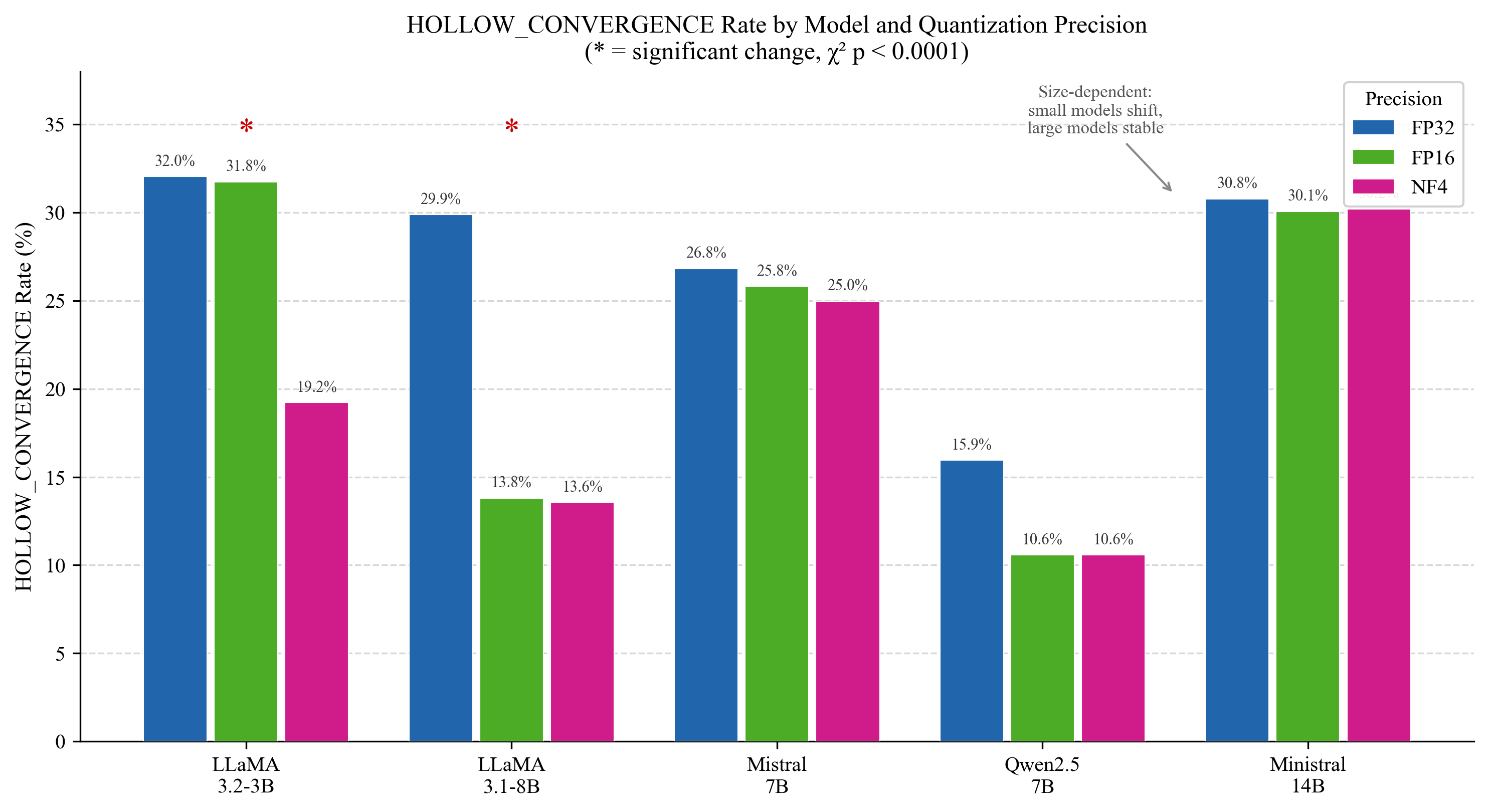
Silent Failures in Quantized LLM Reasoning
A Taxonomy-Based Analysis of Hollow Convergence and Failure Mode Shifts
Comprehensive taxonomy analyzing failure modes when quantizing reasoning models to low precision, revealing "Hollow Convergence": accuracy stays flat under quantization while the way models fail changes significantly (χ² = 234.5, p < 0.0001).
Read on arXiv →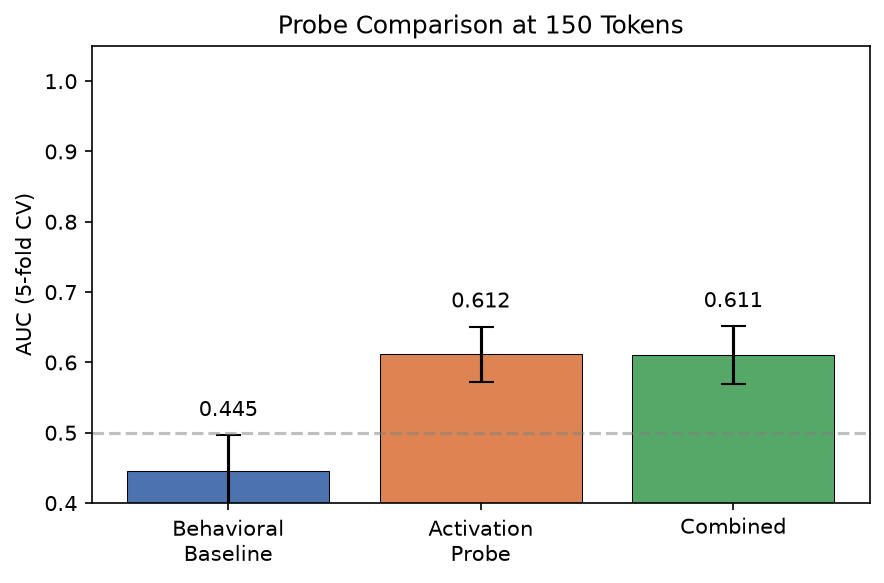
Experience & roles
- Support 47 graduate students on agentic AI architectures, multi-step planning, memory and agent evaluation: grade assignments and quizzes, run office hours, and help students debug their agent projects.
- Evaluated an internal agentic framework across 6 multi-agent production use cases, benchmarking tool-use success and memory retention across 100k+ token contexts: 94% and 98% respectively.
- Using that framework, designed and built an autonomous multi-agent test-generation system with AST-based analysis, first in TypeScript and then generalized to C++ via language-specific parsers, reaching 93% and 85% coverage respectively.
- Benchmarked the system against GitHub Copilot on proprietary system dependencies, measuring a 35-point increase in branch coverage and a 3x reduction in dependency-hallucination errors. The results drove the framework's adoption for enterprise use, and the system was deployed into the client's CI/CD pipeline to automate legacy regression testing.
- Engineered a Python ETL pipeline to parse and structure 1,450+ unformatted market logs from a state agricultural database into relational schemas, cutting downstream data-cleansing latency 42%.
- Streamed processed data through a 3-broker Apache Kafka cluster to handle high-throughput routing between ingestion and analytics services without data loss.
- Trained multivariable regression models in Scikit-learn on environmental features (temperature, weather, humidity) to forecast optimal crop yield conditions, reaching an R² of 0.884.
- Built a full-stack MERN application to serve the models in production and added a WebSocket layer for real-time control, triggering physical hardware state changes on a Raspberry Pi in under 180ms.
- Engineered an automated telemetry pipeline ingesting 4.5M+ time-series data points (wind velocity, torque, battery state-of-charge, thermal readings) from campus sensors.
- Built a signal processing pipeline in NumPy and SciPy to denoise, normalize, and downsample raw sensor streams, improving feature-engineering throughput 38%.
- Trained LSTM and GRU networks in PyTorch to forecast wind energy generation spikes and battery degradation, running hyperparameter sweeps across 50+ configurations to reach an R-squared of 0.912 on battery discharge cycle forecasts.
- Packaged the pipeline and models into a reproducible benchmarking repository, accelerating the lab's energy-load simulation throughput 2.8x.
- Built an ETL pipeline using Hugging Face tokenizers and OpenCV to ingest and temporally align 12,000+ conversational video segments, extracting RoBERTa text embeddings, Wav2Vec 2.0 acoustic vectors, and ResNet-50 facial feature maps.
- Implemented and integrated the published Multimodal Adaptation Gate (MAG) architecture into a PyTorch transformer pipeline, modifying cross-modal attention to inject acoustic and visual vectors into the language model's inner layers.
- Optimized inference by exporting the fused model to ONNX with graph optimization and post-training quantization, reducing inference latency 34%.
- Achieved a macro F1-score of 0.84 on the conversational test set, outperforming single-modality baselines.
Core competencies
Let's collaborate
Interested in discussing LLM systems, agentic architectures, reasoning failure analysis, or production ML. Open to New grad 2027 roles.